


.png)

Programs & Events

Piety with Purpose Conference 2026


FOUNDATIONS
Everything stands on something. In the Qur'an, Allah contrasts the one who builds his life on taqwa and the pleasure of his Lord with the one who builds at the edge of a crumbling cliff. One holds. The other takes the person down with it.
Most of us don't find out which one we built until the ground moves.
Our fourth annual Piety with Purpose Conference is an evening of honest conversation about what we're actually standing on. We'll name the foundations modern life installs in us without asking — the career that became an identity, the self as the final authority, the quiet sense that our worth is something we have to keep producing — and look at how each of them behaves under pressure. We'll sit with the distance between knowing what's true and being able to act on it, and why so many people who have the answers still feel like they're slipping.
Then we turn outward. To a handful of young people in a cave whose hearts Allah made firm as they stood. To the unglamorous work behind every masjid and community any of us has ever walked into. And to a harder question — why so many of us can sit in a full room and still feel like strangers in it.
And we end where it gets personal: what you leave behind, and what your part in it is.
Six speakers. Three conversations. One announcement about what comes next for Thabaat.
Come build with us. 🌲
BABYSITTING
Free babysitting will be available! Ages 3–9 only. lease register all children for babysitting at least 48 hours prior to the event so we're able to plan for their attendance! Please fill out the form and agree to the terms: Babysitting Registration Form.
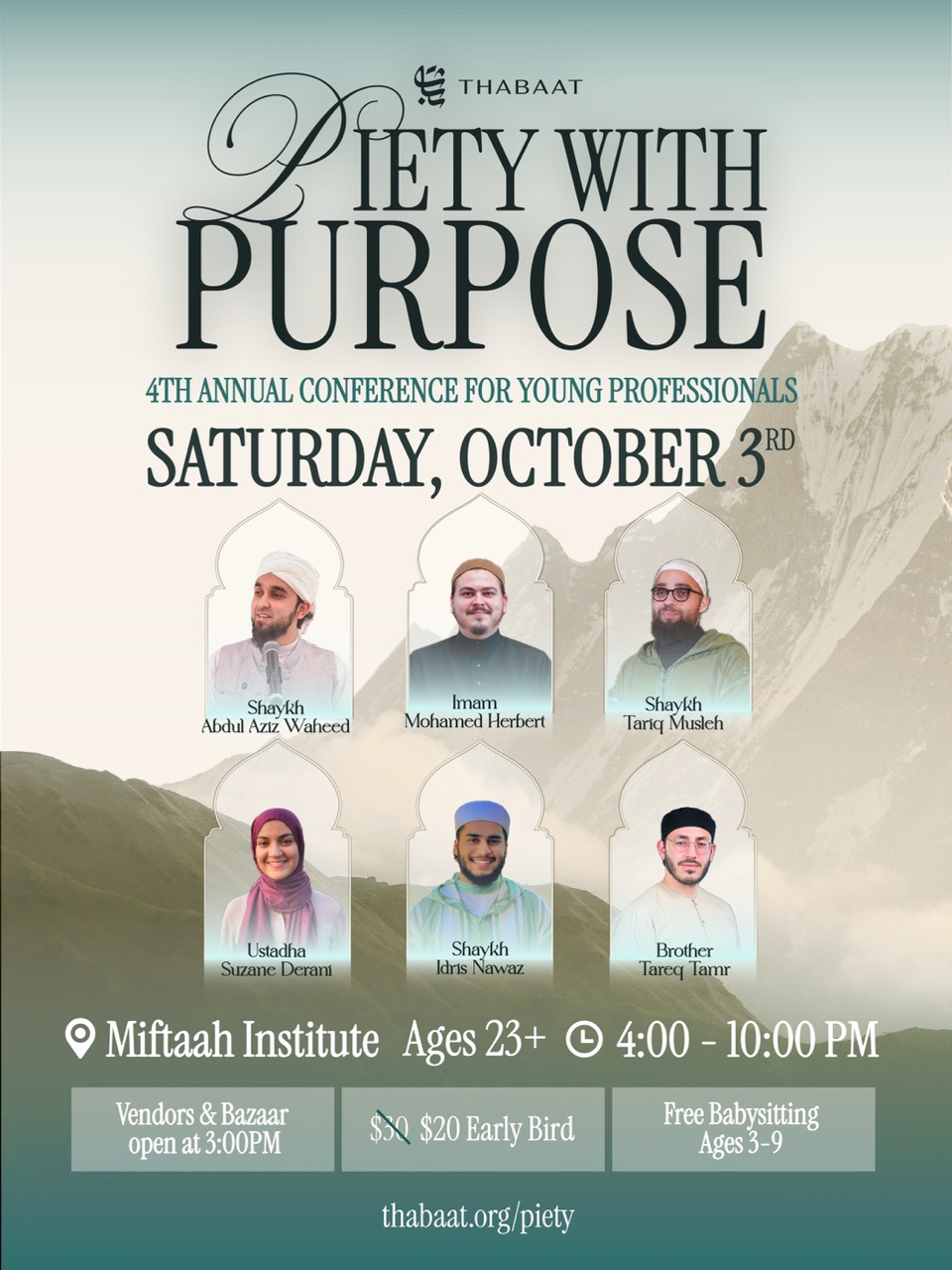

Event Speakers

Tareq Tamr is the Program Director at Thabaat and the Head of Engagement at Yaqeen Institute for Islamic Research. He studied Psychology with a minor in Philosophy and is continuing Islamic Studies on a part-time basis. He grew up in Windsor, ON and has served the local community as a youth director, khateeb, and lecturer for youth and young professionals.

Shaykh Abdul Aziz Waheed is the Resident Scholar of Thabaat. He is a Co-founder of Miftaah Institute and also serves as Dean of Academic Affairs at Michigan Islamic Institute. He began Islamic studies at Jaamiah al-Uloom al-Islamiyyah, where he became a Hafiz. He started his 7 year Shariah program in Toronto, Canada and graduated with honors, receiving Ijazzat for teaching Hadith from prominent scholars from around the world.

Shaykh Tariq Musleh is a graduate from the prestigious Madinah University where he attained his Associate's in Arabic and Bachelor's from the College of Sharia. Shaykh Tariq has worked as a part-time instructor for the Islamic Learning Foundation Chicago, where he taught Quran and Arabic studies. He has served in Young Muslims (YM) for many years as a coordinator and murrabi. Shaykh Tariq has also served as the Youth Director for the Islamic Center of Naperville in Chicago and became the Youth Director and Assistant Imam of Mecca Center in Willowbrook, Illinois in July 2017.
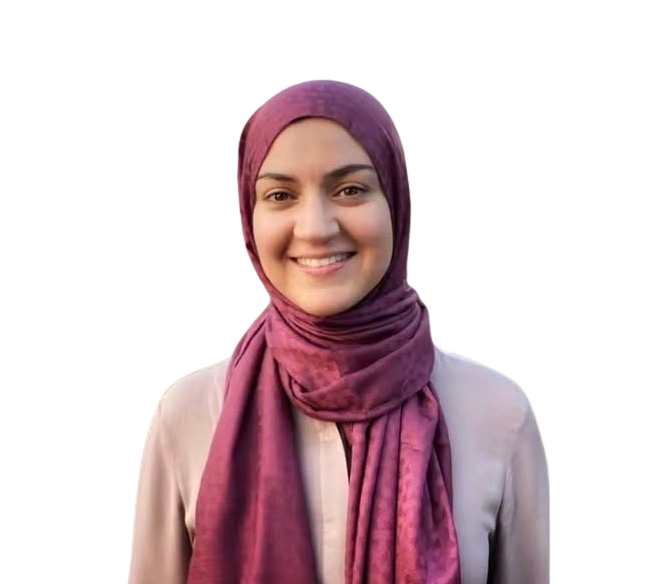
Ustadha Suzane Derani is a Qur’an educator and Muslim chaplain with over 20 years of teaching experience. She began her Qur’anic studies at a young age and later traveled to Damascus, Syria, where she studied Arabic, Seerah, Aqeedah, Shafi‘i Fiqh, and Qur’an. She completed her memorization of the Qur’an at age 18 and received an ijaza in Hafs from Shaykh Abul Hasan al-Kurdi. In 2023, she received her ijaza in the 10 Qirā’āt from Ustadha Saima Yacoub. She holds a B.A. in European and Middle Eastern History and a Master of Divinity, with experience in hospital, hospice, and community chaplaincy. She currently serves as a chaplain with Maristan and on the board of Rahmah Foundation. Ustadha Suzane is also the author of The Qur’an, My Best Friend, and is passionate about helping others develop a meaningful and reflective relationship with the Qur’an. She currently resides in Michigan, where she continues to teach Qur’an, tajwid, and tafsir, as well as mentor youth.
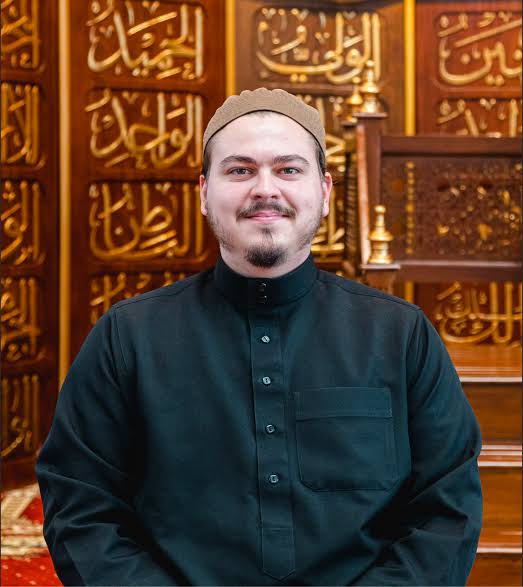
Imam Mohamed Herbert is a scholar, educator, and community leader. Born and raised in Baltimore, Maryland, he completed his memorization of the Qur’an at the Islamic Society of Baltimore before studying Arabic and pursuing formal Islamic studies at Qalam Seminary in Texas. He graduated from Qalam’s Alimiyyah program in 2019 after several years of study while serving as an Imam. He has served Muslim communities in Mansfield, Texas, and Tulsa, Oklahoma, and currently serves as Resident Scholar at the Islamic Center of Johnson County. He is also an Islamic Studies instructor at Legacy International Online High School, where he teaches Tafseer, Fiqh, and Seerah and helps oversee curriculum development. He additionally teaches with Qalam Institute through Qalam Travel and various online courses.
Idris Nawaz memorized the Qur’an by the age of 10 under the instruction of Qari AbdelKarim Edgouch, and in 2015, at just 12 years old, he earned first place at the Qatar International Qur’an Competition, becoming the first American to win an international Qur’an competition. He began his ʿĀlimiyyah studies at the age of 13 at Michigan Islamic Institute, later completing them at Jāmiʿah Binoria University in Pakistan. There, he earned a Master’s degree in Sharīʿah and a second Master's (Takhassus) in Ḥadīth Studies with high distinction. He also served as a lecturer and obtained a diploma in Islamic Banking and Finance from the Institute of Business Administration (IBA). He is currently completing his PhD in Islamic Thought and Philosophy at the International Islamic University of Malaysia, with a research focus on integrating Islamic epistemology with education. He serves as an instructor at Miftaah Institute and Michigan Islamic Institute. He has published and continues to write on Ḥadīth, education, and bioethics, regularly conducts programs and seminars across the United States, and has taught modules on Arabic, modernity and modern ideologies, Ḥadīth Sciences, and apologetics.